
300,000 Images and 93 billion pixels: Moving dam inspections from the field to the desktop

Inspecting the interior of concrete dams is often hindered by poor lighting and restricted access, making it difficult to get a comprehensive overview of the structural condition. By building an ultra-high-resolution 3D model of the galleries at the Storfinnforsen dam, we have demonstrated how visual inspections can be entirely transitioned to a digital desktop environment. The result is an impressive level of detail, allowing for the detection and exact geospatial anchoring of all defects, such as cracks as fine as 0.2 millimeters.
The challenge of confined spaces
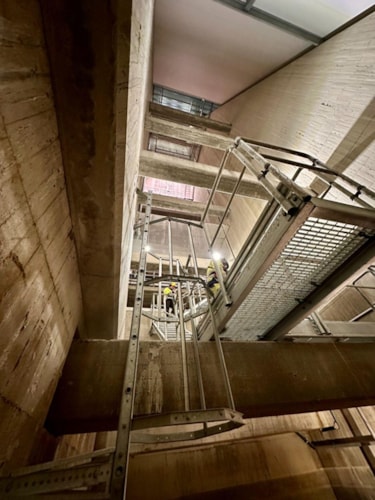
Traditional internal inspections of concrete dam structures, such as galleries and shafts, face significant logistical and environmental hurdles. These confined spaces lack GPS coverage and suffer from inadequate lighting. This often results in fragmented, paper-based documentation, which makes it highly difficult to accurately track how damage progresses from one inspection cycle to the next.
A digital model of Storfinnforsen
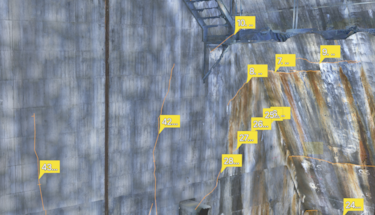
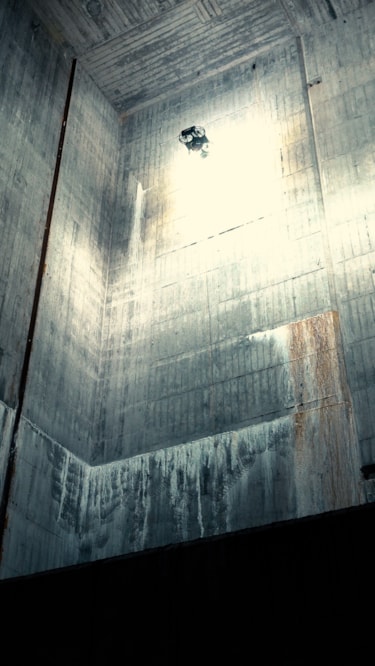
To overcome these challenges, a new technical methodology was applied at the Storfinnforsen dam. The approach focuses on capturing the concrete surfaces using drone technology and mapping the photographs as ultra-high-resolution digital textures onto a 3D model. In this project, an astounding 300,000 high-resolution images were processed to reconstruct the dam's internal surfaces. The resulting 3D-model is built from a staggering 93 billion pixels of texture data.
Project facts: Storfinnforsen
- Data collection: Drone-based image acquisition by Kiwa Technincal Consulting using a tethered drone from ScoutDI.
- Image material: 300,000 high-resolution images.
- Texture data: 93 billion pixels processed by Spotscale
- Inspected area: 3,500 square meters of concrete surfaces inspected by Kiwa Technical Consulting
- Level of detail: Identification and annotation of cracks down to 0.2 mm.
The expert stays at the desk
The major breakthrough of this workflow is that concrete- and structural experts can now perform their entire analyses directly within a digital environment. During the Storfinnforsen project, the experts conducted the visual inspection entirely from their workstations, navigating the 3D model. Every observation and anomaly found is annotated and saved as a geospatial data point at its exact coordinate on the dam's surface within the model.
With every observation digitally anchored, we can return to the exact same coordinate in the future to monitor how a crack develops
Future-proofing dam safety
Because every observation is digitally anchored, the ambiguity of traditional paper-based reporting is completely eliminated. Preserving expert notations in a spatially correct context provides a superior baseline for future comparative analysis. During subsequent inspections, dam safety officers can simply return to the exact same coordinate in the digital model to confidently determine if a defect is stable or progressing. This approach strongly supports a proactive, data-driven strategy for asset management that aligns with international standards.
Contact us!
Would you like to know more about Kiwa Intelligent Inspection services? Fill the form to contact our experts!