
Kiwa is water, water is Kiwa

80 years of drinking water safety
Without water, we couldn’t survive. Ensuring that drinking water is safe, through testing, inspection, and certification, has been part of Kiwa's mission from the very beginning. With the European Union’s recast Drinking Water Directive (DWD) set to come into effect on January 1st 2027, we spoke to Dirkjan van den Berg, Senior Expert Hygienic Aspects at Kiwa, about the new directive, Kiwa’s long history with water, and why that history matters more than ever today.
Kiwa’s history with water
The story begins in 1948. In the aftermath of the Second World War, Dutch drinking water companies set about trying to rebuild a largely destroyed infrastructure. They needed confidence that the piping systems they laid would be safe, intact, and functional for many years. “There were other challenges, too”, says Dirkjan. “Plastics were a new and unknown material, and with them came new questions: Can they withstand pressure? What is their life expectancy? And what effect might they have on the quality of the water passing through them?”
To answer these questions, the Dutch water companies founded Kiwa: a not-for-profit body created to test and certify the products and materials that would be used in the country’s water infrastructure. Water safety wasn’t just one of Kiwa’s early areas of focus. It was the reason Kiwa was founded.
Most people don’t know this, but the name Kiwa started out as an acronym. It stood for the Keuringsinstituut voor Waterleidingartikelen, or the Institution for the Examination of Waterworks Articles. Later, we switched to using Kiwa as a name in its own right, as we started to offer so much more beyond water services.
Back in 1948, early Kiwa team members were checking for the safety of materials in contact with water (photo below). A lot has changed since : most inspectors wear protective outfits and hardhats, not three-piece suits, while the technology has become so much more sophisticated. I just love what the picture represents: while the times have changed, we’re still working for water safety. Water is in our DNA.
The fact that water is part of Kiwa’s history shines through in many ways. The building where Dirkjan works was once a laboratory where large pipes were tested under load. The shape of the roof still bears the overhead beam that was used to lift heavy equipment in and out.
The scope of Kiwa's water work has, of course, expanded. For many years, certification requirements stopped at the water meter, or the boundary between the utility's network and a property's internal plumbing. But internal plumbing, with its narrower pipes and higher surface-area-to-volume ratio, can have a significant impact on water quality. Around ten to twelve years ago, the certification scope was extended to cover it, broadening Kiwa's responsibilities and the number of products it assesses.
From early regulations to the new DWD
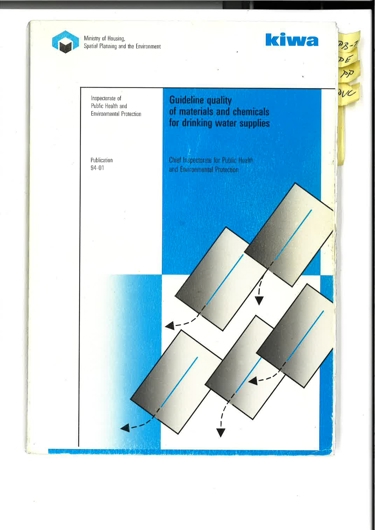
For most of Kiwa’s history, regulations around drinking water were created nationally. Individual countries, such as the Netherlands, Germany, and France, established and managed their own rules. For decades, the baseline for Dutch assessment was a document Kiwa itself had written: what Dirkjan refers to as "the Blue Book", first published in 1994. When the Dutch government was asked to implement an earlier EU directive, it didn't need to start from scratch. The Kiwa framework already existed, so they simply wrote it into Dutch law. The Kiwa framework became Dutch regulation.
After this, compliance was no longer optional. Water companies in the Netherlands had to demonstrate it, and Kiwa became the sole certification body for this type of assessment. For over 20 years, it has remained so.
Now, we are in a new transition. The recast Drinking Water Directive replaces all national frameworks with a single European scheme. From January 1, 2027, manufacturers and suppliers of products in contact with drinking water will need to demonstrate compliance with a harmonized European standard, not just their national one. Kiwa is playing an important part in ensuring that this process leads to an assessment system that is consistent across Europe, Dirkjan explains.
Any legislation, no matter how carefully written, will likely contain gaps and room for different interpretations. The new Directive will be no different. As a result, notified bodies across Europe will process the new rules differently in their assessments. There will be differences in outcome, cost, timelines and more. The result? “Less fairness and less public confidence in the certification system itself”, says Dirkjan.
That’s why Kiwa has taken an active role in bringing the European notified body community together. Dirkjan currently chairs the technical community responsible for resolving the most complex regulatory questions. The chair of the broader group of notified bodies is also from Kiwa. That level of organizational engagement reflects something deeper than commercial interest. "The whole group of notified bodies probably would not exist without the push and initiative of Kiwa," says Dirkjan. "The first meeting of this group was held in our office in Apeldoorn, the Netherlands. We don't just think about ourselves. We think about how the system as a whole can work. And it can't work if all notified bodies are acting on their own, without communication or harmonization."
"In the end, these rules and regulations exist to protect human health," says Dirkjan. "That's their purpose. And it’s part of our purpose. We’re here to ensure that someone can turn on a tap and not have to ask themselves whether the water is safe to drink."
Water safety through collaboration
In the Netherlands, collaboration has always been part of our approach. Certifications, regulations, and rules don’t just come from above. They were developed in dialogue with drinking water companies, product manufacturers, pipe and fitting producers, and the broader market. "We get together deliberately," says Dirkjan. "We discuss what a good requirement looks like. We agree on how to assess it. We define what passes and what doesn't. The best regulations are created through structured collaborations like this."
The DWD took a different path. National hygienic systems were merged and harmonized at a governmental level, with less direct involvement from the market. That gap is something Kiwa is actively working to address. Water utilities, in particular, face a practical challenge: the DWD certifies the hygienic properties of products in contact with drinking water, but does not reference technical issues. “For example, whether a valve will open and close reliably, or whether a pipe will remain intact under pressure for decades”, says Dirkjan. “Those technical performance requirements still sit in national frameworks, and they remain as important as ever.”
In other words, he notes, “A DWD certificate doesn’t mean you’re there. There are other rules and regulations as well. The European Commission describes DWD as a passport for Europe, one system replacing national systems, and that's true for the hygienic aspects. But the technical quality requirements still remain nationalized. You still need to demonstrate compliance with local building regulations. You still need to know that a product actually does what it's supposed to do. That's something we've been making clear to everyone, and it can still come as a surprise.”
To support this message, Kiwa continues offering specific national water certification alongside DWD certification. That way, water utilities can still require a full Kiwa certificate when sourcing products, covering not just hygienic compliance but technical performance too. For water utilities, that continuity matters. The goal has always been good infrastructure, not just compliant paperwork.
80 years in the water industry
With changes coming in the water safety space, it’s the perfect time to affirm once again that Kiwa’s water expertise is not just theoretical. It has come from more than 80 years of hands-on assessment work, across generations of staff, equipment, and regulatory frameworks. “I arrived in 2003, fresh out of college after studying chemistry”, says Dirkjan, “and was handed the Blue Book and asked to start conducting hygienic assessments.”
"I've been here long enough to see the whole arc," he reflects. "When I started, Kiwa had maybe three to four hundred employees. Now we're over ten thousand. The company has branched out into food, oil and gas, Wi-Fi, hydrogen; you name your sector, and we’re probably there. But drinking water is still a significant part of who we are. It's where we came from."
What’s next for water safety?
There are always new ways for Kiwa to apply its water safety expertise. “Take the Middle East, for example”, says Dirkjan. “It’s a region with many desalination processes, creating new challenges. But the expertise is the same, even when the product types and regulatory contexts differ.”
Another example is the service Kiwa has developed to support the EU’s Positive List process: part of the DWD framework that governs which chemical substances can legally be used in products that come into contact with drinking water. Keeping that list up to date requires ongoing submissions of materials from manufacturers. The challenge? Many companies don't know how to navigate the process, and others are reluctant to expose their product compositions. Kiwa has built a service that manages that process on their behalf, pooling submissions where multiple companies depend on the same substance, while protecting confidentiality.
As we look forward, we are ready to play our part, Dirkjan concludes. “We have been doing this for 80 years and, hopefully, we will be doing it for at least 80 more. Simply put, Kiwa is water, water is Kiwa. It’s what we were founded to do. It’s our history. We were founded for it, we’ve always done it, and we’re still doing it.”
Contact us!
Would you like more information about Kiwa's services for the Water makret? Fill out the form and contact our experts.